Macro
When a Shock Becomes a Cascade: Structure Before Downside
Apr 16, 2026

When a Shock Becomes a Cascade: Structure Before Downside
Markets do not move from calm to crisis in a single step.
They transition through structure.
Not through volatility first,
but through structure.
Before downside becomes visible, the system begins to move differently.
Correlation rises.
Independence fades.
Behaviour compresses.
What follows is not just a sell off.
It is a shift in how risk propagates.
System Signal: Structure Tightens First
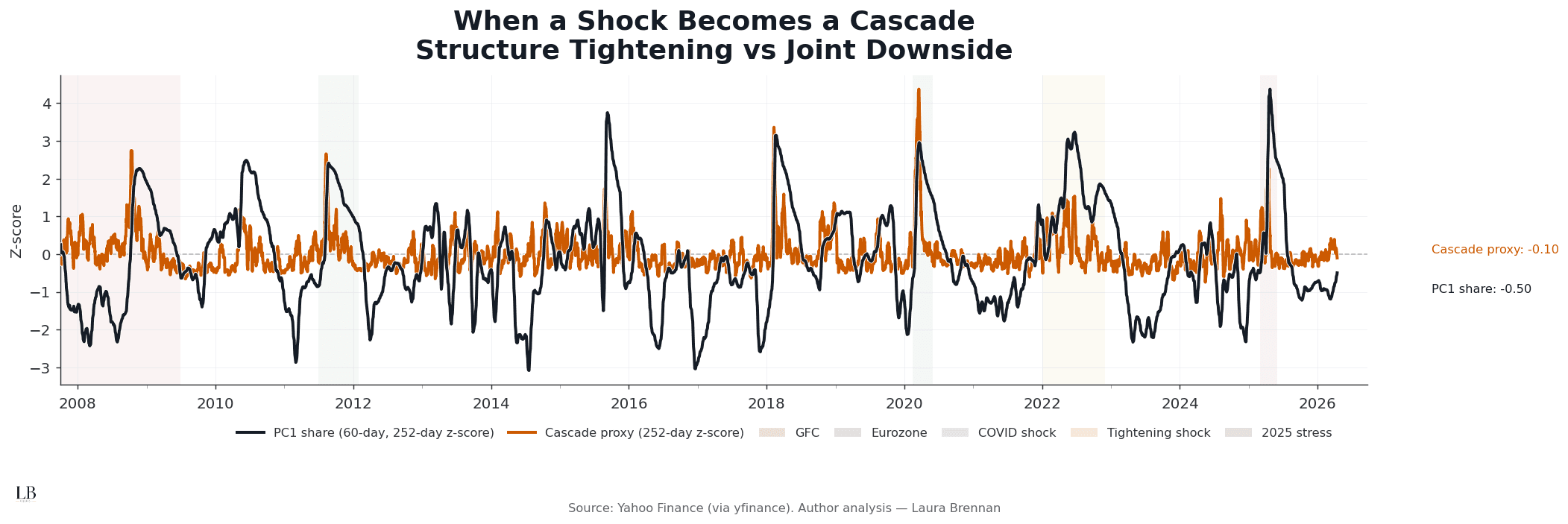
The system begins to move as one.
The first principal component rises, signalling that returns are increasingly driven by a common force rather than independent behaviour.
At this stage, downside is not yet dominant.
But the conditions for it are forming.
Once structure tightens, shocks are no longer absorbed locally.
They propagate.
Participation: Weakness Becomes Broad
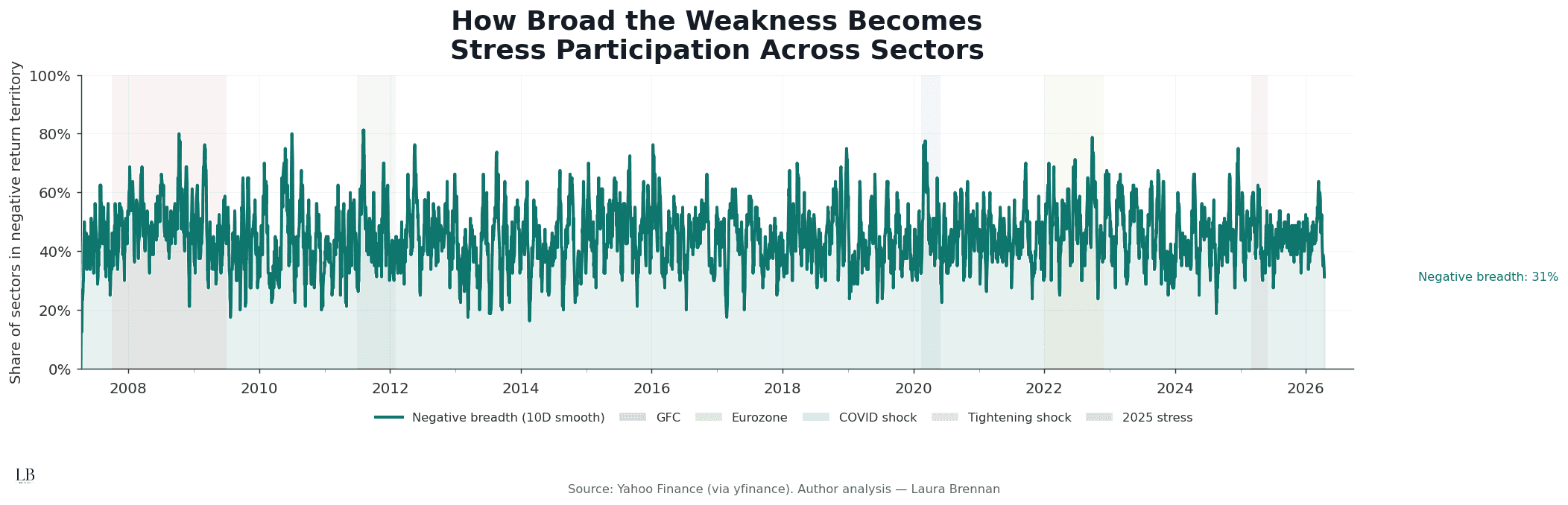
After structure tightens, weakness begins to spread.
The share of sectors in negative territory rises.
This is not yet extreme downside.
It is participation.
Losses are no longer isolated.
They become systemic.
The system is no longer fragmenting.
It is aligning in the wrong direction.
Magnitude: Downside Starts to Cluster
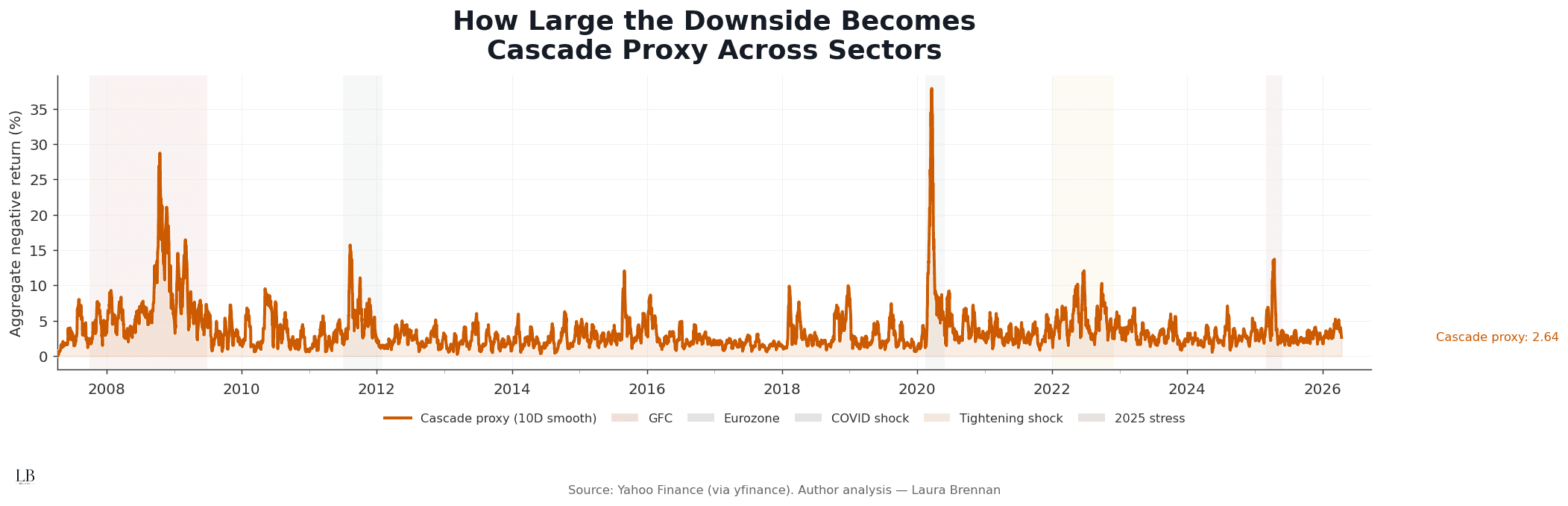
Only after participation broadens does magnitude increase.
Downside becomes concentrated and simultaneous.
Losses are no longer independent events.
They occur together.
This is where a shock becomes a cascade.
Not because volatility appears, but because structure and participation have already aligned.
System State: When Everything Moves as One
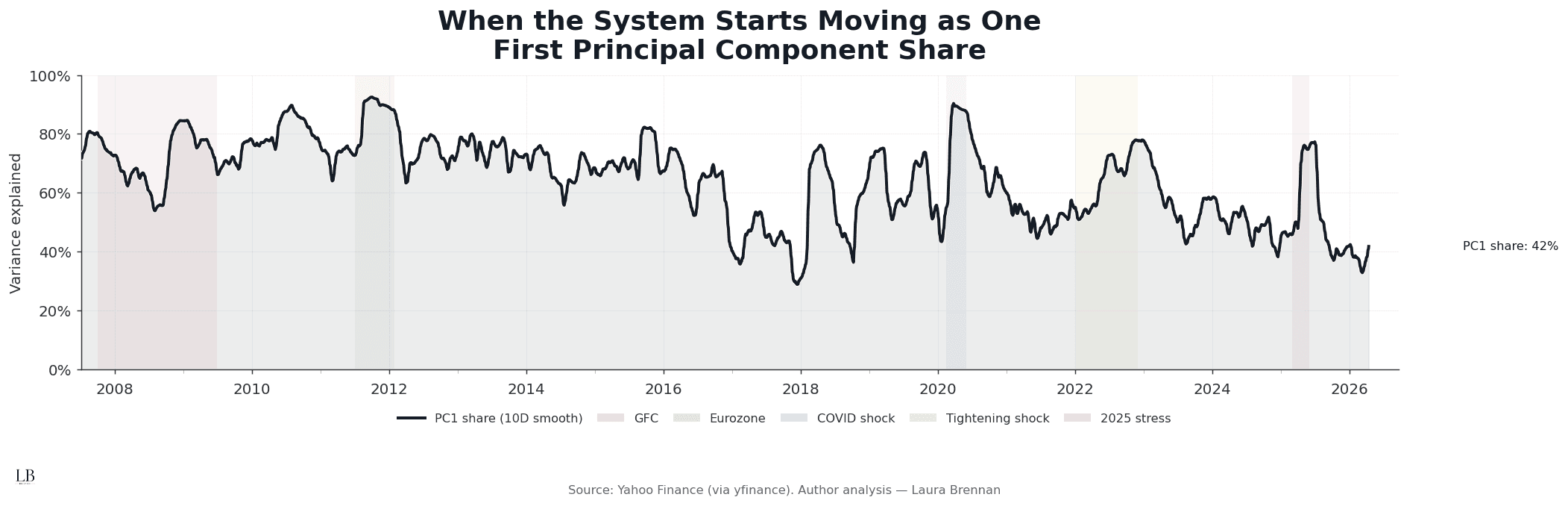
At the extreme, the system behaves as a single trade.
Diversification weakens.
Correlation dominates.
The market ceases to function as a collection of independent assets and instead behaves as a unified system.
This is the environment in which cascades become self reinforcing.
Structural Interpretation
Across all layers, the sequence is consistent:
• Structure tightens first
• Participation broadens second
• Magnitude follows
Volatility does not initiate stress.
It reflects a system that has already changed.
Key Insight
A shock becomes dangerous when the system loses independence.
Not when prices fall, but when behaviour converges.
That is when diversification fails.
And that is when a cascade becomes possible.
Methodology
Assets: US sector ETFs (SPDR)
Structure: First principal component (rolling PCA)
Participation: Share of sectors with negative returns
Magnitude: Aggregate downside (cascade proxy)
Transformations:
• Rolling windows (60D structure, 252D normalisation)
• Z-scores for comparability
• 10-day smoothing for visual clarity
Source: Yahoo Finance (via yfinance)
Analysis: Laura Brennan